
Inspired Education
Back to workshops
BiologyFull-day intensive

Biology — Full-day Masterclass

A focused full-day Biology intensive for the final weeks before the 2026 HSC. Revisit Heredity, Genetic Change, Infectious Disease and Non-infectious Disease and Disorders, then apply that knowledge to data, stimulus material and HSC-style questions with expert teacher guidance.

Date

Thursday 1 October

Time

9:00 am – 4:00 pm

Campus

Macquarie University — room TBC

Availability

30 places left

Students concentrating in a live HSC masterclass

A real InspirationED workshop

Live teaching, guided exam practice and room to ask questions.

Biology · Full course intensive

Connect the biology. Interpret the evidence. Build the response.

HSC Biology tests whether students can use course knowledge, not simply recall it. Across a 100-mark paper, students must interpret unfamiliar data, analyse biological processes, connect evidence to a conclusion and communicate with accurate scientific language. This workshop brings Modules 5–8 and the Working Scientifically skills together so students can make stronger decisions across objective-response, short-answer and extended-response questions.

Best for

Year 12 Biology students who understand much of the course content but want stronger connections across Modules 5–8, more confidence with data and stimulus questions, and greater precision in longer HSC responses.

Aligned to the 2026 HSC

Biology Stage 6 Syllabus (2017)

The 2026 HSC Biology examination is based on the 2017 syllabus. The replacement 2025 syllabus begins with Year 11 in 2027 and has its first HSC examination in 2028.

Syllabus

Reserve this session

Per student

$250

30 places left

1

Instant confirmation after secure payment

The Year 12 course

Every part of the course connected to the way it is examined.

The day connects the Year 12 course with the examination skills students need to apply it.

Module 5 · approximately one quarter of the HSC paper

Heredity

Connect reproduction and cell replication to DNA, polypeptide synthesis, genetic variation and inheritance patterns. Practise using models, pedigrees, Punnett squares and population data to explain how genetic information is transmitted and expressed.

Key language: reproduction · mitosis and meiosis · DNA replication · polypeptide synthesis · genetic variation · pedigrees and Punnett squares · inheritance patterns
Module 6 · approximately one quarter of the HSC paper

Genetic Change

Examine how mutation, gene flow and genetic drift change populations, then evaluate biotechnology and genetic technologies in agricultural, medical and industrial contexts. Focus on explaining processes, interpreting evidence and making justified judgements about benefits, risks and biodiversity.

Key language: mutation · mutagens · gene flow · genetic drift · biotechnology · cloning · recombinant DNA · transgenic organisms · biodiversity

Module 7 · approximately one quarter of the HSC paper

Infectious Disease

Link pathogens and transmission to host responses, immunity, prevention, treatment and control. Practise analysing outbreak and population data, comparing strategies and explaining the interactions between infectious agents, hosts and public-health responses.

Key language: pathogens · transmission · host response · innate and adaptive immunity · vaccination · pharmaceuticals · epidemics and pandemics · disease control

Module 8 · approximately one quarter of the HSC paper

Non-infectious Disease and Disorders

Bring together homeostasis, causes and effects of disease, epidemiology, prevention and assistive technologies. Work with incidence, prevalence and mortality data while building evidence-based explanations and evaluations of prevention, management and treatment.

Key language: homeostasis · negative feedback · non-infectious disease · incidence and prevalence · epidemiology · prevention · assistive technologies · disorders

Across the day

Learn it. Apply it. Improve it.

01 · Consolidate

Reconnect the high-value biology

Revisit the core processes, relationships and terminology across Modules 5–8, with attention to the links students need to make between content areas.

02 · Interpret

Read data, diagrams and stimulus with purpose

Identify variables, trends, relationships, anomalies and biological evidence in unfamiliar graphs, tables, experimental descriptions and models.

03 · Decide

Match the response to the question and marks

Unpack directive verbs, identify the relevant syllabus knowledge and decide how much explanation, evidence, comparison or evaluation the question requires.

04 · Practise

Apply the method to HSC-style questions

Work through selected objective-response, short-answer and longer-response tasks that integrate course knowledge with Working Scientifically skills.

05 · Improve

Use feedback to make the next answer stronger

Review approaches with the teacher, correct misconceptions and refine the accuracy, structure, evidence and scientific language of each response.

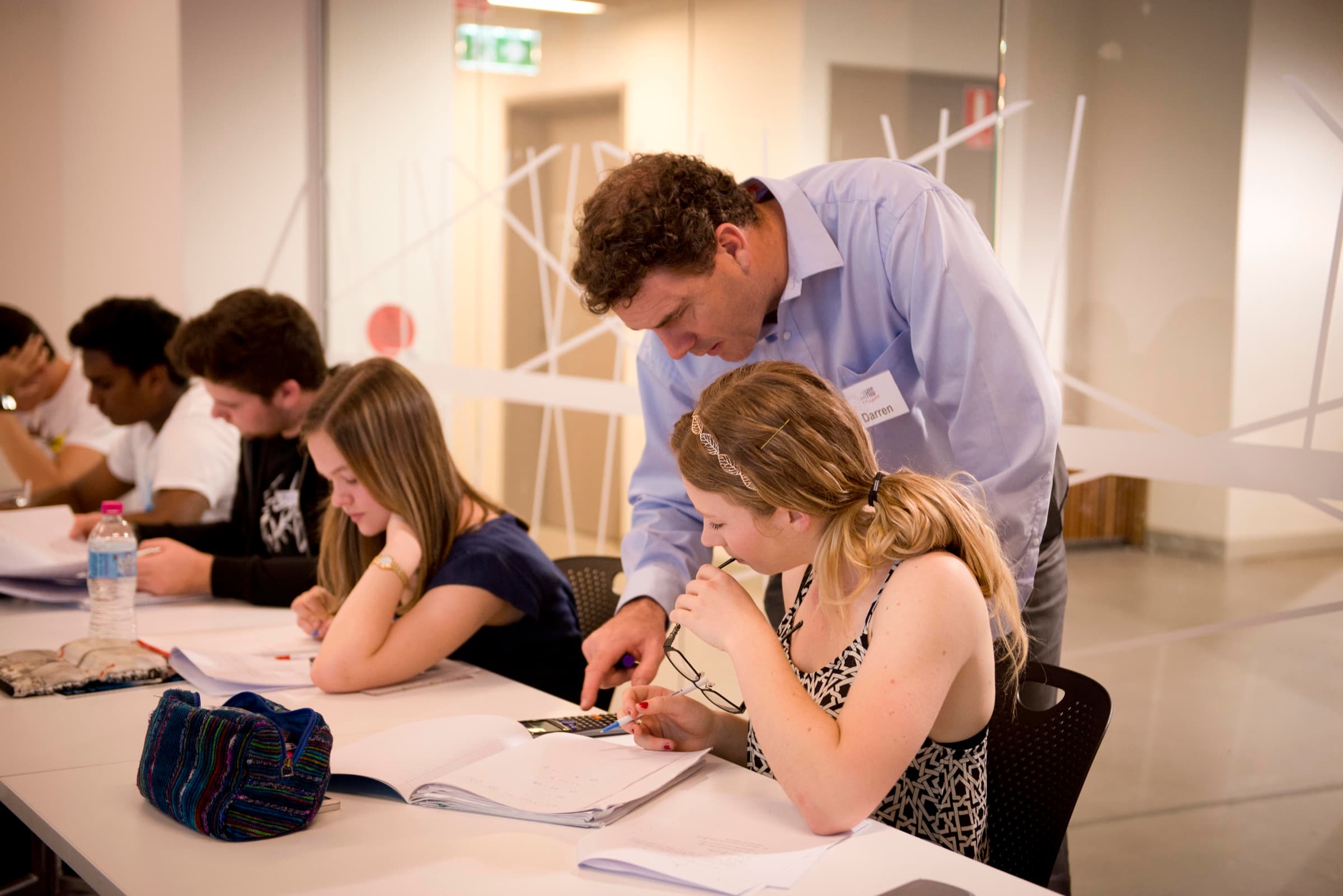
HSC teacher supporting a student during guided practice

Practice and feedback

HSC-style questions, data analysis and feedback that improves the next response

Students work through selected objective-response, short-answer and extended-response tasks across the day. The teacher models how to identify the biological process being tested, extract useful evidence from graphs, tables and diagrams, and match the depth of an answer to the marks available. Students compare approaches, ask questions and use live guided feedback to improve accuracy, reasoning and scientific expression. The workshop provides guided feedback and improvement opportunities rather than a separate individual marking service.

Interpret biological data more confidently

Extract trends and relationships from graphs, tables, diagrams and experimental results, then use that evidence in a defensible conclusion.

Explain processes with greater precision

Sequence biological events clearly, use correct terminology and show the causal links that turn recalled facts into a complete explanation.

Build stronger high-mark responses

Respond to analyse, assess and evaluate questions with relevant evidence, explicit criteria and a sustained judgement rather than description alone.

Connect knowledge across Modules 5–8

Recognise when a question draws on more than one content area and bring the right concepts together without losing focus on the question.

Included with the workshop

A Biology workbook built for active practice and final revision

Every student receives a subject-specific workbook containing concise Module 5–8 notes, biological process summaries, data and stimulus sets, HSC-style practice questions, response-planning frameworks, scientific-writing advice and space to annotate worked approaches. Students use it throughout the day and can return to it during their final HSC revision.

Concise Module 5–8 notes

Clear summaries of the biological processes, relationships and course language students need to use accurately.

Data and stimulus practice

Graphs, tables, diagrams, experimental scenarios and unfamiliar evidence selected for active interpretation.

HSC-style question set

Objective-response, short-answer and longer-response tasks with attention to directive verbs and mark allocation.

Expert advice and collaborative review

Teacher modelling, live guided feedback, opportunities to ask questions and discussion of different evidence-based approaches.

Expert HSC educators

Premium take-home resources

Marking insights and exemplars

Common questions

Does the workshop cover all four Year 12 modules?

Yes. The day reconnects Heredity, Genetic Change, Infectious Disease and Non-infectious Disease and Disorders. It focuses on high-value concepts and transferable examination skills rather than attempting to reteach every syllabus dot point in one day.

Will we work with practical and experimental questions?

Yes. Practice includes interpreting experimental methods, variables, validity, reliability, accuracy, data and conclusions. The workshop uses written and stimulus-based investigation questions; it is not advertised as a full laboratory practical day.

Is this aligned to the 2026 HSC syllabus?

Yes. The September 2026 workshop uses the Biology Stage 6 Syllabus (2017), which remains the syllabus examined for the 2026 HSC. The replacement 2025 syllabus has its first HSC examination in 2028.

Who is this workshop for?

Year 12 students preparing for their final school assessments and the 2026 HSC examinations.

What should I bring?

Bring a laptop or tablet if you use one for study, writing materials, water and lunch. Your workshop resources are provided.

When will I receive the exact room?

Building, room and arrival instructions are sent by email with the ticket and again before the workshop.

Can I book several workshops?

Yes. Add any three workshops in one order and the $75 bundle saving is applied automatically at checkout.