Inspired Education
Back to workshops
Mathematics AdvancedFull-day intensive

Mathematics Advanced — Full-day Masterclass

A focused full-day Mathematics Advanced intensive for the final weeks before the 2026 HSC. Reconnect Functions, Trigonometric Functions, Calculus, Financial Mathematics and Statistical Analysis, then apply those ideas to objective-response and open-ended HSC-style problems with an expert HSC teacher.

Date

Tuesday 29 September

Time

9:00 am – 4:00 pm

Campus

Macquarie University — room TBC

Availability

30 places left

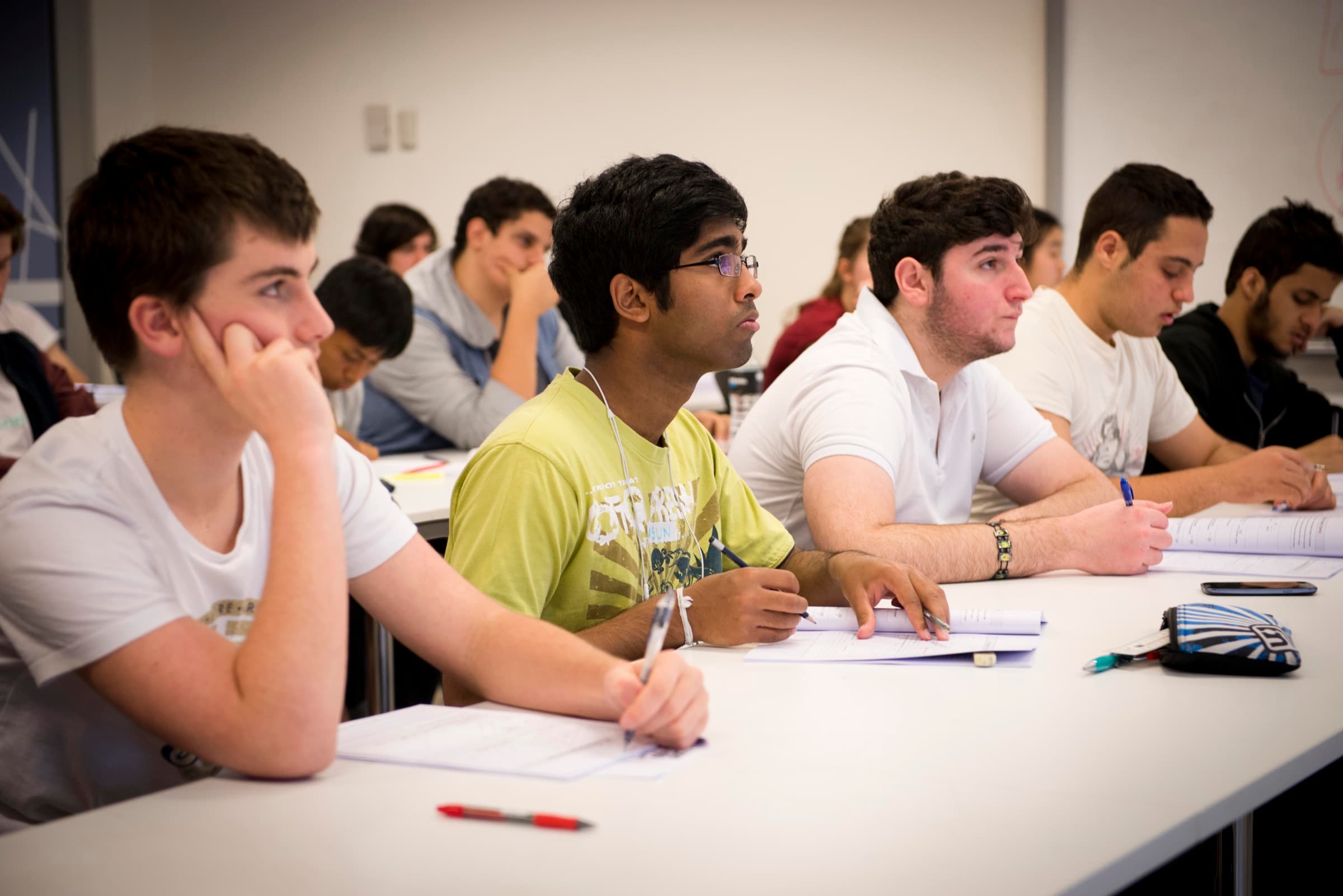
Students concentrating in a live HSC masterclass

A real InspirationED workshop

Live teaching, guided exam practice and room to ask questions.

Mathematics Advanced · Full course intensive

Recognise the method. Show the reasoning. Finish the problem.

Mathematics Advanced rewards more than remembering a formula. Students must identify the mathematics inside unfamiliar wording, choose an efficient method, connect ideas across the course and communicate working precisely. This workshop brings the five Year 12 topics together through guided examples, genuine problem solving and practical checking habits for the three-hour HSC examination.

Best for

Year 12 Mathematics Advanced students who know many of the core methods but want greater consistency with unfamiliar questions, multi-step problems, mathematical communication, calculator use, accuracy and examination timing.

Aligned to the 2026 HSC

Mathematics Advanced Stage 6 Syllabus (2017)

The 2026 HSC Mathematics Advanced examination is based on the 2017 syllabus. The replacement 2024 syllabus begins Year 12 in Term 4, 2026 and has its first HSC examination in 2027.

Syllabus

Reserve this session

Per student

$250

30 places left

1

Instant confirmation after secure payment

The Year 12 course

Every part of the course connected to the way it is examined.

The day connects the Year 12 course with the examination skills students need to apply it.

Year 12 topic · Graphing Techniques

Functions

Connect algebraic features to the shape and behaviour of graphs. Practise using transformations, symmetry, intercepts, asymptotes and domain information to sketch, interpret and solve problems efficiently.

Key language: graphing techniques · transformations · symmetry · intercepts · asymptotes · domain and range · equations and inequalities
Year 12 topic · Trigonometric Functions and Graphs

Trigonometric Functions

Work with trigonometric graphs, identities, equations and modelling. Strengthen the links between exact values, periodic behaviour, transformations and the algebraic decisions needed in unfamiliar problems.

Key language: trigonometric graphs · identities · equations · period and amplitude · transformations · modelling · exact values

Year 12 topic · Differential Calculus · The Second Derivative · Integral Calculus

Calculus

Bring differentiation, the second derivative and integration into one connected problem-solving toolkit. Practise tangents and normals, curve behaviour, optimisation, rates of change, motion, definite integrals and areas while keeping working clear and logically sequenced.

Key language: differential calculus · second derivative · integral calculus · tangents and normals · curve sketching · optimisation · rates of change · motion · areas

Year 12 topic · Modelling Financial Situations

Financial Mathematics

Translate financial contexts into effective mathematical models. Practise recurrence relations, compound interest, loans, annuities and future-value calculations while interpreting variables, time periods and the reasonableness of results.

Key language: modelling financial situations · recurrence relations · compound interest · reducing balance loans · annuities · future value · repayments

Year 12 topic · Descriptive Statistics and Bivariate Data Analysis · Random Variables

Statistical Analysis

Interpret data, association and probability with precision. Practise bivariate analysis, discrete random variables and the normal distribution, with attention to notation, calculator output and conclusions written in the context of the problem.

Key language: descriptive statistics · bivariate data analysis · correlation · least-squares line · random variables · probability distributions · normal distribution · z-scores

Across the day

Learn it. Apply it. Improve it.

01 · Consolidate

Reconnect the high-value methods across the course

Review the central ideas, notation and connections across the five Year 12 topics, including the Year 11 knowledge that the HSC paper assumes.

02 · Diagnose

Recognise the mathematics inside the question

Identify what is given, what is required and which topic or combination of topics is being tested before committing to a calculation.

03 · Plan

Choose an efficient method and sequence

Select formulas and techniques deliberately, set out a workable path and decide where algebraic, graphical or calculator methods are most useful.

04 · Practise

Apply the method to HSC-style problems

Work through objective-response, open-ended and multi-step questions that require students to combine course knowledge and communicate mathematical reasoning.

05 · Check

Use feedback to find and fix avoidable errors

Review solutions with the teacher, improve the clarity of working and use substitution, estimation, graphs, units and context to test final answers.

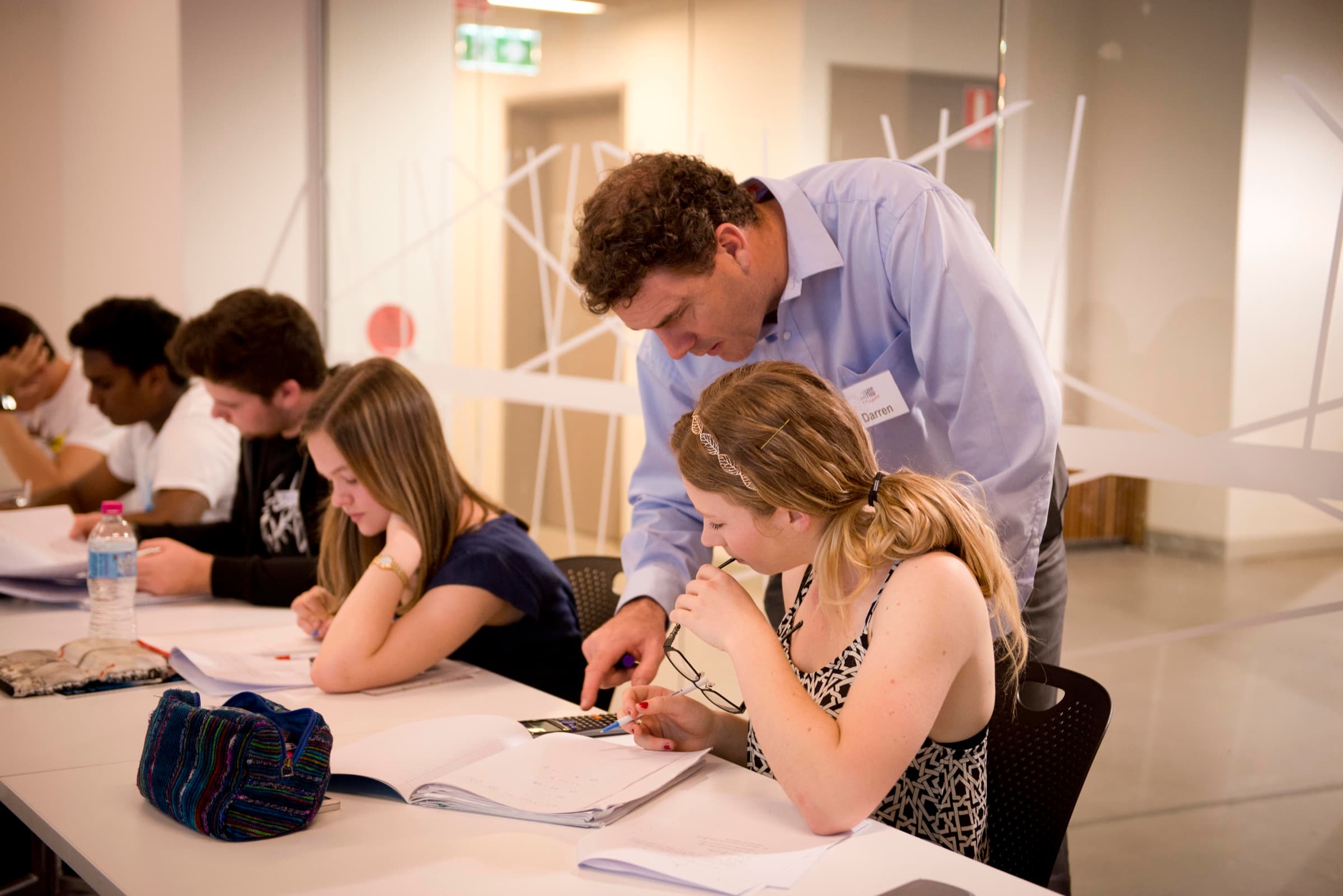
HSC teacher supporting a student during guided practice

Practice and feedback

Guided HSC-style problem solving with feedback students can use immediately

Students work through a purposeful mix of objective-response and open-ended problems. The teacher models how to identify the topic and givens, choose a method, sequence working and test whether an answer is reasonable. Students then apply the approach, compare solutions, ask questions and correct errors through live guided feedback. The workshop develops method, reasoning and independence rather than providing a separate individual marking service.

Choose a suitable method more confidently

Recognise familiar structures inside unfamiliar wording and select an efficient algebraic, graphical, calculus, statistical or financial approach.

Set out clearer mathematical reasoning

Show the steps, notation and conclusions needed for an open-ended response rather than relying on an unexplained calculator result.

Handle multi-step and connected problems

Move between representations and combine ideas from different parts of the course without losing the logic of the solution.

Reduce avoidable errors under time pressure

Use efficient checking habits for algebra, calculator input, rounding, units, domains and contextual interpretation while managing a three-hour paper.

Included with the workshop

A practical Mathematics Advanced workbook for the day and final revision

Every student receives a subject-specific workbook containing concise topic notes, method reminders, worked approaches, HSC-style mixed questions, space for full working and a checking framework for common algebraic, graphical, calculator and interpretation errors. Students use it throughout the workshop and can continue with it in the final weeks before the HSC.

Concise topic notes and method reminders

A focused reference for the five Year 12 topics, key connections and techniques students need to recall accurately.

Objective-response and open-ended practice

HSC-style questions that develop both efficient decisions and the full working required for multi-mark problems.

Worked approaches and checking frameworks

Practical models for setting up a solution, communicating reasoning and checking whether an answer is mathematically and contextually sound.

Expert advice and collaborative review

Teacher modelling, live guided feedback, opportunities to ask questions and a focused room where students can compare useful solution paths.

Expert HSC educators

Premium take-home resources

Marking insights and exemplars

Common questions

Will the workshop reteach the entire Mathematics Advanced course?

The day connects all five Year 12 topics and revisits high-value assumed knowledge, but it is not a line-by-line reteaching of every syllabus dot point. The focus is on the methods, connections and examination decisions that produce the greatest benefit close to the HSC.

Should I bring a calculator?

Yes. Students should bring their usual NESA-approved calculator and know its basic functions. The workshop develops efficient calculator use alongside the algebra, reasoning and working that still need to be shown. The official Mathematics Advanced reference sheet is supplied in the HSC examination.

Is this aligned to the 2026 HSC syllabus?

Yes. The September 2026 workshop uses the Mathematics Advanced Stage 6 Syllabus (2017), which remains the syllabus examined for the 2026 HSC. The replacement 2024 syllabus is first examined in the 2027 HSC.

Who is this workshop for?

Year 12 students preparing for their final school assessments and the 2026 HSC examinations.

What should I bring?

Bring a laptop or tablet if you use one for study, writing materials, water and lunch. Your workshop resources are provided.

When will I receive the exact room?

Building, room and arrival instructions are sent by email with the ticket and again before the workshop.

Can I book several workshops?

Yes. Add any three workshops in one order and the $75 bundle saving is applied automatically at checkout.