Inspired Education
Back to workshops
PhysicsFull-day intensive

Physics — Full-day Masterclass

A focused full-day Physics intensive for the final weeks before the 2026 HSC. Reconnect Advanced Mechanics, Electromagnetism, Nature of Light and From the Universe to the Atom, then practise applying evidence, equations and clear scientific reasoning in HSC-style questions.

Date

Friday 2 October

Time

9:00 am – 4:00 pm

Campus

Macquarie University — room TBC

Availability

28 places left

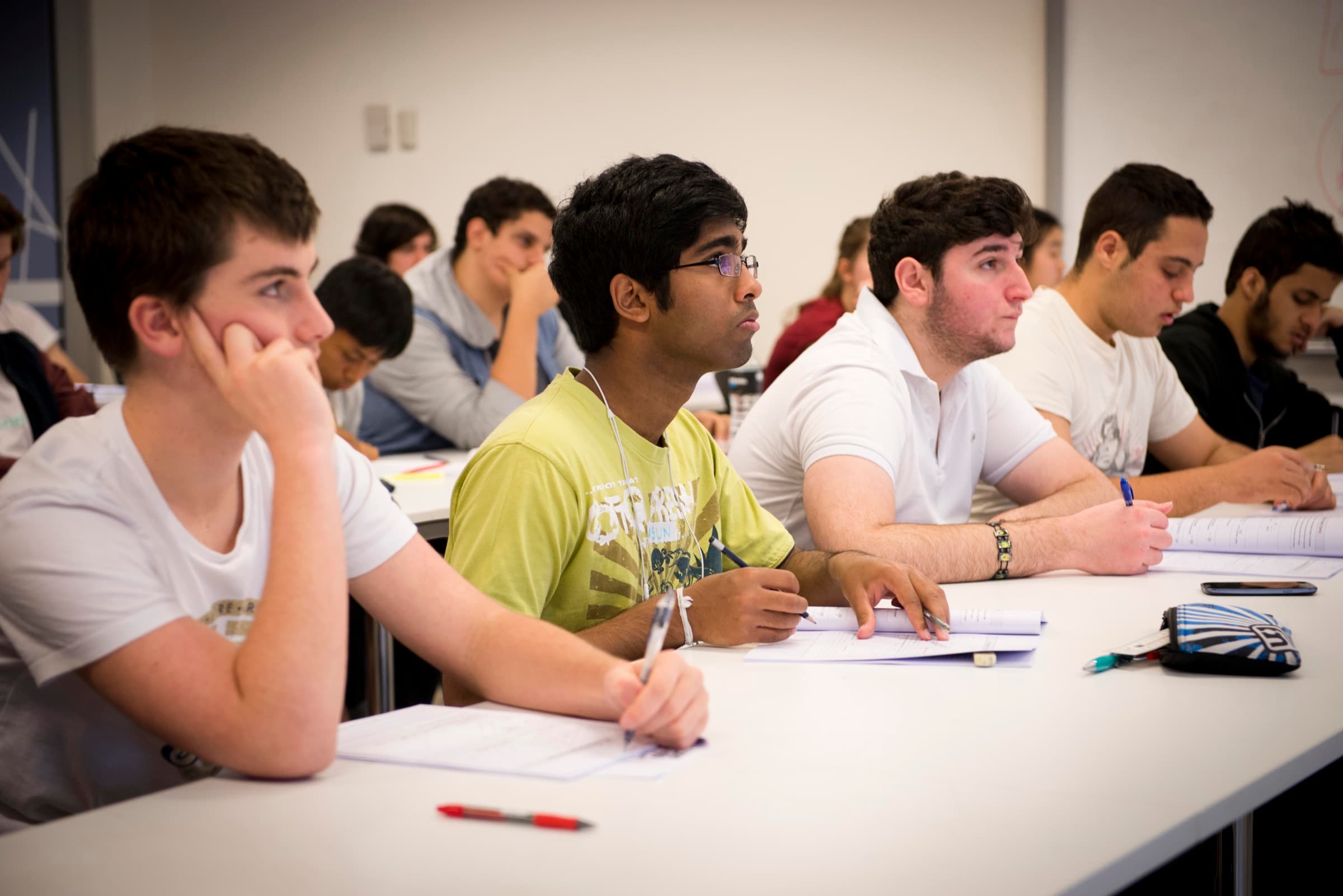
Students concentrating in a live HSC masterclass

A real InspirationED workshop

Live teaching, guided exam practice and room to ask questions.

Physics · Full course intensive

Read the situation. Build the model. Explain the physics.

HSC Physics rewards students who can connect concepts, diagrams, data and mathematical relationships in unfamiliar contexts. This workshop brings Modules 5–8 together through guided calculation, data-analysis and extended-response practice, including the Working Scientifically skills integrated through the HSC paper.

Best for

Year 12 Physics students who know much of the course but want a clearer approach to multi-step calculations, data and practical questions, unfamiliar scenarios and precise scientific explanations.

Aligned to the 2026 HSC

Physics Stage 6 Syllabus (2017)

The 2026 HSC Physics examination is based on the 2017 syllabus. The replacement 2025 syllabus begins Year 12 in Term 4, 2027 and has its first HSC examination in 2028.

Syllabus

Reserve this session

Per student

$250

28 places left

1

Instant confirmation after secure payment

The Year 12 course

Every part of the course connected to the way it is examined.

The day connects the Year 12 course with the examination skills students need to apply it.

Module 5

Advanced Mechanics

Connect projectile motion, circular motion, gravitational fields and motion in a straight line. Practise using diagrams, vectors, data and equations to build a model and explain a physical situation.

Key language: projectile motion · circular motion · gravitational fields · forces · vectors · kinematics · data analysis

Module 6

Electromagnetism

Strengthen the links between electric fields, magnetic fields, induction and motors. Practise applying field models, circuit ideas and quantitative relationships in unfamiliar contexts.

Key language: electric fields · magnetic fields · electromagnetic induction · motors · generators · circuits · field models

Module 7

Nature of Light

Use wave and quantum ideas to explain light phenomena. Practise ray diagrams, interference, diffraction, special relativity and evidence-based explanations using precise physics language.

Key language: wave model · ray diagrams · interference · diffraction · special relativity · quantum model · evidence

Module 8

From the Universe to the Atom

Connect astrophysics, cosmology, quantum physics and nuclear physics. Practise interpreting evidence, mathematical relationships and models that explain systems from atomic to universal scale.

Key language: astrophysics · cosmology · quantum physics · nuclear physics · models · evidence · data interpretation

Across the day

Learn it. Apply it. Improve it.

01 · Reconnect

Consolidate the high-value ideas

Review the concepts, equations, representations and Year 11 knowledge that link Modules 5–8.

02 · Decode

Work out what the physics question requires

Identify the system, variables, model, evidence and command verb before deciding how to respond.

03 · Plan

Build a solution students can trust

Select equations and evidence deliberately, organise full working and plan a clear scientific explanation.

04 · Practise

Apply the method to HSC-style tasks

Attempt objective-response, calculation, data, practical-investigation and extended-response questions.

05 · Refine

Use feedback to improve precision

Correct weak modelling, calculations and explanations, then check units, graphs and the reasonableness of conclusions.

HSC teacher supporting a student during guided practice

Practice and feedback

Guided HSC-style practice with feedback students can apply immediately

Students work through objective-response, calculation, data-based, practical-investigation and extended-response questions. The teacher models how to identify the model, select equations and evidence, show working and check a conclusion. Students practise, compare approaches and improve their work through live guided feedback.

Choose and apply an effective physics model

Recognise the key system and relationships inside unfamiliar wording, diagrams and data.

Set out reliable calculations

Use equations, units, significant figures and full working to make quantitative reasoning visible.

Apply Working Scientifically skills

Analyse data, uncertainty, validity, reliability and limitations in practical-investigation questions.

Write clearer scientific explanations

Connect evidence, models and precise terminology to a conclusion that answers the question.

Included with the workshop

A practical Physics workbook for the day and final revision

Every student receives concise module notes, HSC-style practice questions, calculation and graph frameworks, practical-investigation prompts, common-error checks and space to annotate worked approaches.

Concise module notes and key equations

Clear reminders of central concepts, relationships and scientific language across Modules 5–8.

HSC-style calculation and data practice

Questions spanning objective-response, practical-investigation, quantitative and extended-response decisions.

Planning and checking frameworks

Practical structures for modelling a situation, selecting an equation, showing working and checking conclusions.

Expert advice and collaborative review

Teacher modelling, live guided feedback, questions and a focused room for comparing useful solution paths.

Expert HSC educators

Premium take-home resources

Marking insights and exemplars

Common questions

Will we complete laboratory experiments on the day?

The workshop focuses on the practical-investigation skills assessed in written HSC questions: interpreting methods and data, evaluating uncertainty and limitations, and proposing justified improvements. It is not advertised as a laboratory practical session.

Is this aligned to the 2026 HSC syllabus?

Yes. The workshop uses the Physics Stage 6 Syllabus (2017), which remains the syllabus examined for the 2026 HSC. The replacement 2025 syllabus is first examined in 2028.

Who is this workshop for?

Year 12 students preparing for their final school assessments and the 2026 HSC examinations.

What should I bring?

Bring a laptop or tablet if you use one for study, writing materials, water and lunch. Your workshop resources are provided.

When will I receive the exact room?

Building, room and arrival instructions are sent by email with the ticket and again before the workshop.

Can I book several workshops?

Yes. Add any three workshops in one order and the $75 bundle saving is applied automatically at checkout.